

What Makes a Good Fanatic? The Big Guns Get Philosophical
As a freelancer, I have a lot of jobs, but one of the most enjoyable is editing transcripts for the Pew Forum on Religion & Public Life. The task involves many solitary hours spent combing through the words of distinguished experts of religion. It’s an immersive experience, and I pay far more attention to the ideas presented while editing than I usually do to the stream of information I consume each day online and elsewhere. This concentrated intellectual engagement brings me back to the best moments of college and graduate school, that feeling of being alone, yet surrounded by a timeless world of ideas and thinkers.
My assignment this past week was particularly exciting — and intimidating. The speaker was Peter Berger, perhaps the most distinguished sociologist of religion alive today; and coming from a family of sociologists, I am perhaps more reverential than most to such a title. (When I edited Berger’s earlier talk at the Pew Forum, I was inspired by his insights to write an article on how Americans are switching their religious identities now more than ever — a headline that presaged the findings of Forum’s recent Religious Landscape Survey.)
At this event, held March 4th, Berger tackled one of the biggest religious questions ever: How to balance doubt and faith. Responding to Berger’s remarks were no less than commenter David Brooks and eminent professor of religion, Seyyid Hossein Nasr. The intellectual firepower didn’t end there, however — the small audience was populated by more heavy hitters, including people like sociologist Amitai Etzioni and author Michael Gerson.
If it all sounds a little ivory tower, it was — gloriously so. The conversation zoomed around the room like a graduate seminar, except all the students were professors, and the professors were making a lot of jokes. I didn’t attend the event in person, and in normal life, I would never take the time to read the complete transcript, so I wanted to boil it down for others to access: Here is my unauthorized play-by-play, complete with outrageous paraphrasing, extra room for jokes, and the occasional money quote. Enjoy.
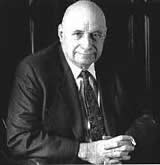 Peter Berger, convener of a just-finished two-book project on fundamentalism and relativism
Fanatics have a big advantage in politics: They have nothing else to do.
Here’s his basic take on fundamentalists. The world used to be a more certain place. We lived in small communities; we took our world views for granted. Now the world is fragmented, interconnected, complex — in a word, modern. Those old small-town or small-village certainties were confining, but they were also very cozy. Fundamentalists want to recreate that certainty. The good news is, that’s very hard to do on a large scale. So if they can’t conquer the world with their certainties, they do the next best thing: create a tiny insular community of certainty and try to expand it.
Relativists, on the other hand, are totally psyched about the lack of consensus. Enter post-modern literary critics talking about “narratives,” and how each narrative is morally right in its own way.
The moral end result of this world view can be captured by imagining a television interview with a cannibal. “You believe that people should be cooked and eaten. I certainly don’t want to be judgmental, but the audience will be interested. Tell us more.”
Berger doesn’t want to be a relativist, and he doesn’t want to be a fundamentalist. He seems to have a healthy share of doubt, so the question for him is about finding certainties. He’s reflected on it a lot, and here’s what he’s concluded: He does indeed have some rock-bottom moral certainties. These are not dependent on the historical truth of his own faith, but on the moral attention he pays to other human beings. Berger’s central moral truth is — as the post-war German constitution puts it — “Human dignity shall be inviolable.”
And how does Berger- and therefore the rest of us-arrive at this moral truth? The same way Huck Finn realized he wasn’t going to turn in Jim, the runaway slave. Sure, if Berger had lived during slavery times, he might have felt slavery was okay. But here’s how you break through the immoral social conventions of your time: You pay attention to the human beings in front of you. Once that awareness of other people’s humanity sinks in, over time, it gradually becomes a moral truth, which gains greater authority over time.
Here’s someone who exemplifies this religious middle ground: Helen Susman, for a long time the only anti-apartheid member of the South African parliament.
In one of my favorite moments, when speaking in parliament, she suggested to the cabinet that they go and visit the black townships, but that they should go disguised as human beings.
So this is the “vibrant middle ground” Berger advises us to occupy, especially in a time of extremes.
It’s hard to find an interesting, vibrant middle ground — i.e. not just a void — in politics as in religion. He sees two possible ways of going about it.
First, you can take a conservative, secular approach, like Adam Smith does. Smith pays attention to culture and says we all have a little voice in our head — he calls it the “impartial observer” — that tells us what is right and wrong. This voice is an accumulation of social input from friends, family and the larger culture. So, just like conservative all-star Edmund Burke says, human wisdom accumulates over time, so be wary of new ideas that rock the boat. Brook’s real hero, here, however, is a guy I’ve never heard of: British philosopher Michael Oakeshott, who, besides having a cool name, also holds that moral truth grows organically out of culture and human observation — not abstract principles. This is the secular, conservative claim to the religio-political middle ground: We don’t know much, but what we do know, we should hold onto.
The second approach is shinier and newer, since it’s based on modern neuroscience, which teaches us three important things:
That most of cognition happens below awareness, that we’re highly social creatures formed in subconscious ways by the loops and social contagions and norms around us, and that we really learn emotionally more than rationally.
The implication here is actually the same as the first approach: We know things intuitively, and therefore we should hesitate to throw out the truths we do know. The problem with fundamentalism and relativism is they want us to ignore our intuitive grasp of truth, so we should avoid both. That’s Brook’s philosophical/neuroscience claim to the middle ground.
But here’s a point to complicate things: Relativists can also be absolutist. The obvious paradox is relativists saying, “Everything is relative” — that’s an absolute. So it’s like yin and yang: There is a little bit of fundamentalism in relativism and probably vice versa.
Here’s another problem: Hossein Nasr doesn’t think the inviolability of human dignity is a statement that can escape philosophical examination. In other words, there is no such thing as a face-value truth, in his view. Every belief has a philosophical underpinning, and since philosophies differ, it’s harder than you think for all of us to recognize and agree on this basic “truths.” Without jeu de poker online gratuitesregles poker pdfjeu de poker onlinepoker games netjouer 7 card stud,play 7 card stud online,7 card studpoker en virtuelune r?gle du jeu du pokeromaha poker r?glesstud pokerastuces texas holdemboite de jeu de pokerjeu video pokerwww poker netla r?gle de jeu pokerle meilleur jeu de pokerlive pokerregles du poker texas holdemjouer poker omahapoker sur netjeu flash poker gratuitesjeu de poker gratuites francaisregle de pokerjouer poker tour en lignepoker school onlinejeu de poker pcholdem poker en ligne gratuitesjeu poker casinocomment jouer o pokercomment apprendre ? jouer au pokerjouer pro poker tourjouer poker omaha gratuitescomment t?l?charger jeu pokerpoker sans internetregles poker holdemtelechargement jeu pokerle poker en lignejouez au poker gratuitestelecharger winamax pokerjeu de poker 3djeux gratuitstournoi texas holdempartie poker en lignejeux de poker en lignelogiciel poker gratuitesapprendre a jouer o pokerjuego omaha poker gratisfree pokerjugar poquer lineastrip poker gamesgame poker a philosophical backing, a belief in human dignity becomes nothing more than sentimentality, selectively applied. Look at the causalities of innocent civilians in Iraq: is anyone in the US really paying attention to that? So even when it comes to these universal moral principles, as Berger suggests, we all have our own particular take on them.
Now to talk about the Muslim world in particular. The middle ground is under assault there. Hossein Nasr recalls growing up in Iran, how Muslims and Armenians and Jews and Zoroastrians all lived side by side peacefully, accepting one another. And since lots of verses in the Qur’an empahsize this Islam-with-a-small-”i,” it was all good. But there are other verses in the Qur’an that are exclusivist (he notes that every religion’s scriptures have such exclusivist statements,) and when modernism, in the form of aggressive secularism, came along, it prompted young people in the Muslim world to shun “the other.” This sentiment led to the support for Wahhabi ideology and other tragic results like Osama bin Laden.
The theological middle ground in Islam is rich and has a long history — and of course Rumi is its most popular proponent these days. But the fundamentalists have “melted away” the middle ground [analogy alert for journalists - the religious middle ground shrinking like an Arctic icesheet.] So we need to fight for this middle ground.
Peter Berger takes issue with Hossein Nasr’s challenges: Berger wants to disagree right away with Hossein Nasr’s assertion that basic moral principles like the dignity of human life require philosophical underpinnings (which, let’s recall, can have the downside of being divisive.) The whole project that Berger, together with Os Guinness and others, conceived of boiled down to this: Can we have religious faith without certainty? During this project, Berger observed in himself that his moral thinking differed from his thinking about politics or other issues. In other words, he felt certain of some moral convictions in a way he did not feel certain about other beliefs. He wonders where this certainty comes from. He looks to his faith as a “theologically very liberal Lutheran.” And he concludes that his moral convictions arise from his own perceptions:
God is not available for inspection, but the slave is available for inspection. It seems to me the rock-bottom moral judgments we make are not theories or the result of theories, but are things we see, we perceive.
Matthew Crawford, a fellow at UVA’s Institute for Advanced Studies in Culture (and author of the forthcoming and very interesting-looking “Shop Class for the Soul“) ask a question: Crawford wants to know from Berger: Okay, but how does this work? How does someone like Huck Finn rise above the moral conventions of his time and perceive the basic humanity of Jim?
Berger replies: Perceptions about slavery are relative — if we’d lived back then, we might have been okay with it — but once the perception of the wrongness of slavery occurs, that moral insight “claims absoluteness,” and more so over time.
A vision of public life that is a framework within which people are allowed to be true to their differences and yet negotiate those differences civilly. And, without that, you’ll have the middle ground constantly disappearing.
Berger responds: “The meaning of fundamentalism hasn’t been dictated by an angel. Obviously, one can define it in many different ways.” Fundamentalism is the attempt to recreate the taken-for-grantedness that was lost with modernization and now globalization. Modern life is so taxing. Choice becomes a burden. Berger sums it up with a joke:
Two friends meet, and one looks very sad, and the other says, “Why are you so unhappy?” He says, “It’s my new job.” “What’s your new job?” “I work in an orange grove, and all day long I sit under a tree, and people bring me oranges. I have three baskets: for the big oranges, the little oranges, and the in-between oranges. That’s what I do all day.” And the friend says, “It seems to me like a very easy job. Why are you unhappy?” And the other man replies, “All those decisions.”
David Brooks wonders: How does a good fanatic develop? He offers an answer to this, and to Matthew Crawford’s earlier question. First, someone notices that what’s going on in their society doesn’t match up with the sense of morality they have inherited. [For example, a future abolitionist begins to feel slavery doesn’t square with Jesus’ message.] Then comes an emotional reaction, a sympathy for those who are being wronged and a disgust toward the wrong-doer. This emotional element is key, because, as we learned from our earlier foray into neuroscience, reason derives from emotion.
Look at the Civil Rights Movement. Gunnar Myrdal said Americans could be educated to overcome racism.
Martin Luther King, having a darker view of humanity based on Niebuhr and other things said, “No, people are too nasty; we really have to be fanatical.” So he self-consciously embraced a fanaticism, as you say, exactly because you need to be somewhat fanatical in order to create that social change.
So Brooks seems to agree with Gerson: There can be such as a thing as a “just fanatic.” But how does the Good Fanatic avoid the pitfalls that lead to becoming a Bad Fanatic? Good fanatics should leave an inch for doubt and uncertainty. Like an asymtote, their fanaticism should approach certainty, but never completely reach it.
Berger describes his own religious doubt with a story:
I have a good friend who’s a Lutheran theologian. He said to me years ago that he never had any serious doubts about the basic propositions of the Christian faith. He said he tried, because he’s a modern intellectual, and he thought he should have doubts—(laughter)—but he never doubted. I had to say to him, “That’s all very interesting. I don’t dispute what you say. It’s not my case, okay? I have to live with the fact that I don’t know any of the things I would affirm as a Christian.” I think people in other religions are in pretty much the same position if they are honest.
Berger says living with doubt, while still believing, is actually helpful. He’s not sure he would want to be more certain. And it’s not right to say Martin Luther (the original Martin Luther) was a fanatic: He was actually plagued by doubt his whole life; for him, faith was a sort of desperate leap.
 Amitai Etzioni, perhaps the only famous sociologist who blogs.
Ditto for the Muslim world. According to so many surveys, the vast majority of Muslims around the world do not advocate violence. [For more data, see my interview with Gallup’s Dalia Mogahed.]
If we imply that all religious fundamentalists are violent, we will actually alienate the peaceful ones and push them toward the extremist camp. So we have to distinguish among fundamentalist and see the non-violent ones as potential allies.
And a bit of criticism for Berger: Using slavery as an example is too easy. Of course we can all agree on that: Who’s going to say they’re for slavery? But if that’s all we can agree on, we have a pretty limited common ground:
One of my colleagues tried to see what values all societies share, because presumably that is one source for building some moral consensus. She found out that all societies agree that in a revenge killing, you shouldn’t kill more than eight people. (Laughter.) That is not a very rich moral language.
Berger explains his project: Berger’s religious views haven’t changed much since he was a young man. But one day he asked him: If he woke up tomorrow as an atheist, what about his moral views would change?
I decided: absolutely nothing. The only thing I could think of was suicide, and even that I wasn’t sure of—(laughter)—because I think if God is merciful, and I can’t stand it any more, he’ll understand if I knock myself off.
So this led to a series of reflections, and Berger brought in other Christian and Jewish thinkers, and they all tacked these questions about doubt and faith.
Steven Lagerfeld, editor of the Wilson Quarterly, wonders why no one is talking about the relativists: If this discussion had taken place 10 years ago [i.e. before the culture war was overshadowed by the war on terror], the focus might have been more on the dangers of relativism. Is everyone here seeing the relativists as benign? As automatic members of the middle ground?
David Brooks has some biting words for academics: The ideology of relativism that was so prevalent until recently in the American academy has “withered away.”
The [new] dominant ideology is professional career advancement, which is to say prudence—(laughter)—which is the ultimate middle ground.
In fact, Brooks doesn’t think the country is polarized by relativists and fundamentalists.
If you look around the country, people are like you. They believe without having certainty about belief, and that’s why I think the country is fundamentally culturally healthy…. Even the evangelical community is a very doubting and ambivalent community, even about fundamental moral questions.
Berger warns that Brooks is not speaking for Europe: Relativism, in the form of an extreme multiculturalism, is a big issues in Europe, especially in the question of how to integrate non-Western immigrants.
Hossein Nasr squeezes in a point about the new atheists: The new atheist best-sellers have further changed the dynamic. The atheists used to be considered the relativists. But if you read some of their books — well, they are quite fundamentalist in their outlook.
End of discussion! You can read the complete transcript here.
 Powered by FireStats
Comment by Vuyiswa Ke-tu-rah Dhlamini on 4 May 2008:
Please help to get in touch with David Liepert my 0027-72-995-6883 or 0027-71-575-8069 its urgent
Vuyiswa