

Sally Quinn: On Faith Blog Is Opening Minds — and Growing Fast
(Below: Sally Quinn, courtesy of wpni.com.)
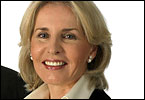 Started by two leading journalists with little background in religion,‡ On Faith, the multi-contributor blog at Washington Post.Newsweek Interactive, has rocketed to prominence since it launched in November, 2006. Although washingtonpost.com said it does not have data on unique visitors to On Faith and its twin blog, PostGlobal, a similarly formatted “conversation” on global affairs, these two opinion sections together register the highest number of unique visitors after the home page, according to spring 2007 figures. Washingtonpost.com as a whole receives 8 million unique visitors a month.
On Faith moderators Jon Meacham, the managing editor of Newsweek and author of a recent book on the religion of the founding fathers, and Sally Quinn, a long-time Washington reporter, pose searching questions each week, such as “Is America a Christian Nation?” to which a star-studded panel of experts — and the general public- respond. One question posted in December — Why is atheism enjoying a certain vogue? - currently has more than 1,600 comments, the majority of which are long, detailed and thoughtful.
While some religion journalists have enthused about the site, others have questioned whether, as an aggregator of opinions, it serves any news function, and whether the interfaith atmosphere favors more liberal writers. ReligionWriter put these and other questions to Sally Quinn, who spoke about the niche On Faith fills, its planned expansion, and her own “freelance polytheism.”
‡Note: Jon Meacham is the author of the 2006 book, American Gospel: God, the Founding Fathers and the Making of a Nation.
ReligionWriter: How did your recent interest in religion translate into the blog format of On Faith?
Sally Quinn: I did a piece for The Washington Post’s “Style” section about seven years ago about religion in Washington. I quoted one hostess saying, “Darling, no one ever talks about religion, it’s simply not done.” That piqued my interest: I realized there was an underground of religious people in Washington.
Then, of course, when Bush got into office and all this talk about evangelicals started, I realized religion had a huge impact on politics. I watched poor old [Howard] Dean and John Kerry flounder around in the South and the Midwest, trying to talk about their faith. They are Northerners, and Northerners don’t do that. It was clearly a problem. Then with 9/11 and the war in
I decided to write a book about religion in Washington, so I started my own research. I felt we weren’t doing enough religion coverage in the Post at that time. Last summer I got the idea to do the website. I suggested it to Don Graham, and he said, “Why don’t you do it?” I said, “I don’t know anything about the internet, and I don’t know anything about religion (laughs.)” Nobody’s perfect.
As it turns out I’m moving away from the book idea. I’m taking all the stuff I would have put it in my book and putting it on the site instead.
RW: So On Faith was filling a gap inside the Beltway?
Quinn: Yes. In the old days, when you went to a dinner party, nobody would talk about going to the church or the synagogue. I’ve been shocked in last year to learn some of my friends actually go to church and synagogue. Not only that, a lot of my friends who are agnostic or atheists never admitted it. Now people are coming out and saying, “I’m an atheist.” People are much more willing to talk about it now, and I think that’s healthy.
My whole goal is to have an interfaith dialogue. People not only don’t understand each other’s religions — they don’t understand their own religions. The more you understand about another person’s faith, the more sympathetic you’ll be to them, it seems to me. You suddenly realize most religions are alike in a lot of ways, particularly in the basic tenets.
RW: I have a question for you from Jeff Weiss of the Dallas Morning News. He asks, why do you think On Faith has been so popular?
Quinn: First of all, we’ve got this amazing panel, there’s never been one like it before, with so many of the world’s leading theologians and scholars and thinkers. That’s been a big draw. Some of our panelists are rock stars in their own areas. I’m amazed: You can’t get them on the phone; they’re always doing interviews and speeches and writing books. They all have big followings, so their people who are interested read the website. A lot of schools and colleges and universities are beginning to use this as a resource, and in some cases using it as part of their curriculum.
Plus, I also think the questions are interesting. We’ve got these “guest voices.” We had a question about Mormons last week, and as a guest voice we had Bill Marriot, Senator Harry Reid of Nevada, and Martha Beck, who wrote a book called Leaving the Saints — those are interesting people who have really interesting things to say.
Sometimes panelists who have written books do a guest voice, and we link to their books. It’s better than doing a book review, because people can actually see what it is and read an excerpt of the book. Then we do a question around a book.
T.D. Jakes has a book coming out about repositioning your life. I’m doing a piece about him for the Post “Style” section, and he’s doing a guest voice, and we’ll link to an excerpt of his book. The question we’re asking to the panelists is: Are you satisfied with where you are in your life now? We’ve got guest voices from Bob Schieffer, George Stephanopoulos, Tim Russert and my very own husband, Ben Bradlee, who are all at different stages of their lives: George is in his 40s, Tim is in his 50s, Schieffer’s in his 70s, and Ben is 85. At Easter time, we had Tom Hanks’ wife, Rita Wilson, who’s Greek Orthodox, do a piece about Greek Easter, and how they celebrate it for a whole week.
People know when they go to On Faith they are going to learn something and be entertained and have something to think about.
RW: Jeff Weiss, always a provocative question-asker, also has this question: “Given that most of your bloggers are on the left, are you doing more than preaching to the choir? Are minds being changed?”
Quinn: We do have evangelicals and right wingers. People like Rick Warren and T.D. Jakes are not what you’d call liberals. We’ve had Billy Graham’s daughter as a guest voice, and we’re trying to get her, or Franklin, or Billy, to be on the panel. Sometimes it’s harder to get people who are more conservative.
We have Catholic theologians, but it’s hard for us to get people who are actually in the church. We’e reached out to many different cardinals and priests who don’t want to do it because they are worried about what they might say, or what the church might say.
So we do have a problem: A lot of people we’ve reached out to just don’t want to do it. But we do have Cal Thomas and Richard Land and Michael Otterson — people with different opinions. I’ve had a number of panelists say to me, “I never would have thought of talking to this person, much less being sympathetic. Yet when I read what they write, I say, ‘I never thought of it that way.’” I wouldn’t say minds have been changed; I would say minds have been opened.
RW: How did you manage to assemble such an all-star panel?
Quinn: I started out with Karen Armstrong, who’s a friend and a mentor to me, and Martin Marty, who’s a friend, and Elaine Pagels. The three of them are so well regarded that when I called up people and said, “Here’s who I have; everybody else said yes. The only turndowns we’ve had are from people who are reluctant to say what they really think, or think On Faith is not a safe place to say it. Bishop Tutu is a friend, so I got him. Then Jon Meacham reached out to people he knew like Rick Warren and Richard Land. I met Susan Thistlethwaite and T.D. Jakes at Aspen last year, and it went on like that.
RW: Even if the panelists don’t write every week, how can you maintain their involvement in the long term? Won’t they get burned out?
Quinn: Next week, we have a question on atheism, “Is religion man-made?” We will reach out to Richard Dawkins, Sam Harris, Daniel Dennett and Susan Jacoby and ask them to contribute. Christopher Hitchens, who has a new book God Is Not Great, will do a guest voice, and we’ll link to an excerpt. Then we’ll have atheist and non-atheist guest voices.
RW: I have a question here from Gary Stern, who reports and blogs on religion for The Journal News. He says he finds the On Faith questions very general and asks, “Do you ever want your contributors to go deeper and get into the nuances of belief?”
Quinn: That’s an issue we talk about every week. If we ask questions that are more specific, we get fewer responses from panelists, even though we might get a lot of hits from readers. If the questions are really specific, panelists look at it and say, “This is not my area.” So we’re constantly trying to find balance between questions that anyone can answer — like “are you satisfied with life?” — and more specific questions. Recently we had one about whether Catholics are still being discriminated against, and we had very few answers.
I would like to make a personal request to all the religion bloggers out there: Give us your ideas. I love these questions you’re asking, they are all the right questions. We’ve only been up for five and a half months, and we’re constantly reassessing. I would love to hear from people.
RW: I know some religion journalists look at On Faith and say, “It’s just opinion. It can’t help me with my reporting.” How do you think journalists can benefit from On Faith?
Quinn: I work closely with Lisa Miller, the religion editor at Newsweek. We have four religion writers at the Post — they are really ramping up the team there. We want to create a whole religion section on washingtonpost.com, where we can have their religion stories, the news wires, and things from other people, so we’d have something like a religion magazine, and On Faith would be part of that.
But you’re right, there’s not a lot of active journalism. That’s why I want to get the religion people at the Post and pull it all together, because On Faith is not really a site for hands-on journalism.
We are getting to point where we’re starting special projects. We have one coming up with imams from all over the world, and I think that’s going to be a huge news maker. We’re partnering with Georgetown University. We’re going to do all the presidential candidates in the fall — have them actually come to Georgetown and talk about their faith — and we hope that will be news making. But we’re just growing. We’re trying to come up with new ideas. I’d love to hear from journalists about how we could make it more appealing to journalists.
RW: A visitor to On Faith could literally spend hours clicking through all the commentary. Is there a point when the amount of content just becomes too overwhelming?
Quinn: You don’t have to read everything. It’s like a daily newspaper: you can go through and find what you want. I’d rather have people say there’s too much than say it’s too thin.
RW: Though one reason some people stop subscribing to newspapers is they are simply depressed by how big the papers are, how much they can’t consume.
Quinn: We keep our guest voices to about 250 words, so they’re short. We’re also starting to do more video. We had one about St. Mary’s City in Southern Maryland, which was founded by Catholics who fled persecution in England. We have a video of a Catholic guy who became a paraplegic after a car accident while a college student at Notre Dame, and how his faith has sustained him. We have this Sufi rock star, Salman Ahmad, and we’re going use his music video, and we had a woman who did [Hindu devotional] carnatic music. We’re also going to do some videos of wounded soldiers and their faith at Walter Reed.
I’m going to start doing some video interviews — what Jon Meacham calls “The Sally Show.” Video is going to make it more lively and appealing to those who just want quick hits.
Keep in mind, we don’t have a staff yet. It’s our editor, our producer and me — it’s just the three of us to keep this thing going.
RW: Are you confident you’ll be able to get the resources you need?
Quinn: Yes, absolutely.
RW: What’s your day-to-day involvement with On Faith?
Quinn: It’s 24/seven. I’m not kidding. I’m at my computer starting at 8 oclock in the morning, and I’m in and out, but I’m here at 11 oclock at night. It’s totally full time.
RW: Do you worry about burnout?
Quinn: I’ve never been so excited about anything I’ve done in my entire life. I am absolutely consumed by this. I just took a three-week trip around the world to study the origins of the great faiths — we went everywhere, and I learned so much: seeing these people with all different kinds of faiths, and their devotions that are so different but so similar. I find it riveting; I just can’t get enough of it.
RW: The obvious question, then, is how this has affected your own beliefs.
Quinn: I was an atheist until a year ago and a half ago, I’ve written about that. Jon Meacham talked me out of that, saying, “Don’t define yourself negatively.” I wouldn’t call myself an agnostic, only because I think we’re all agnostics — none of us knows for sure.
There are pieces of each religion I find compelling. Many things I find a turnoff. I don’t like the doctrine or rigidity of some religions. I’m very much, “Live and let live; I’ll respect you, you respect me; and we’ll all live happily ever after.” I’m now writing about book about myself, how I got where I am, instead of the book about Washington.
I so hesitate to use the word spiritual, because it’s become such a tacky pop word, but I’m much more interested in spirituality than dogma. I don’t believe in a personal God, but I believe in the Spirit. What’s magic or sacred for me, the things that give me the most joy, are my family and my friends -I know it sounds so trite — and the work I’m doing now. If you do something you think is helping people, and I believe that’s what we’re trying to do, it can be incredibly satisfying. We all have to find out in our lives what gives us sustenance, and that’s what works for me.
RW: Karen Armstrong has described herself as a “freelance monotheist” and talks about her work as a religious pursuit in and of itself. Do you ever feel that way?
Quinn: I would say I’m more of a freelance polytheist (laughs.) There’s this beautiful goddess of compassion in Tibet, and I felt, “I can believe in that.”
Yes, there is an enormous amount of fulfillment in doing this work. As Karen talks about, what we are all searching for in our lives is the divine. Before this, I did my work, I tooled along, but I wasn’t really impassioned about anything. I didn’t feel the gratitude that I do now.
Comment by Mark O'Keefe on 7 May 2007:
Insightful questions AND answers!
Comment by mitzi morris on 18 March 2008:
Darlings,
the former style writer and pretentious DC hostess/snob is finally becoming an expert on religion and a surrogate for Barack Obama and apologist for his hateful, biased Rev Wright and his church.
Quinn is an a
embarassment to any group that seriously examines theology and social discourse within religion. Wright and Farrakhan are obvious anti-semites, and let me laugh before I hear Quinn’s rationalizations for these odious and destructive positions and preachings of hate. The very idea that “whites don’t know about the black churches” is nonsense.
We know now and it’s awful.
Comment by Richard Rhodes on 5 September 2008:
Pelosi has 5 children. What is she doing in Washington. Obama has two young children he has no business being in the senate or running for president. He is a father and he has abandoned his children at a young age because of his arrogance. obviously he doesn’t care about them.
Comment by Imogen on 6 September 2008:
Richard Rhodes - I don’t understand your comment, how is career ambitions related to level of parenting and how is that linked to the topic at hand. Regarding Obama surely the best thing he can do for his girls is to become president and improve the society in which they live so he can show them how he was a force for helping people…
Back on topic I think that anything that promotes dialoge between people of different religions is a good thing. There’s too much xenophobia around, and if On Faith can increase people’s knowledge of ‘the other side’ that can only be a good thing!
Comment by Farhanahz on 10 September 2008:
Dear Mr. Rhodes:
I found your comments quite amussing. If your ratinale were to be implemented, nobody will leave their houses, with the exception of course of those who are sterile or their children die. By the way, if you really believe your statements, Ms. Palin should be in Alaska with her kids.
For us humans, it is so easy to transfer our failures, frustations and inadequacies on others. We need to understand that as people are different, the things that are important for them are also different. You may want to adopt my motto: If I don’t pay your rent/mortgage, your kids are not mine, I’m not the one feeding you, dressing you or paying your for health insurance; I have no saying in how you live your life.
Comment by Patrick Wells on 7 November 2008:
Dear Sally Quinn,
I am a movie producer making my 7th movie; it is called AT JESUS’ SIDE. Please visit my Web site at http://www.atjesussidemovie.com and watch our 3 and ½ minute promo (not a trailer).
The secret of the success of THE PASSION OF THE CHRIST was that the movie was about Jesus Christ, as is our movie. After THE PASSION OF THE CHRIST, I wanted to make a movie about Jesus just for children and families. The structure of our movie was modeled after BEN HUR, one of my favorite movies and my first real introduction to Jesus Christ at age 16(my parents were agnostics) but we have more scenes about Jesus. This is the perfect film to introduce children to Jesus Christ. I am 65 years old.
I would like to send you a DVD of my movie. I would hope to get your support and possibly an endorsemen.
We just screened our animated movie AT JESUS’ SIDE at the Chicago International Children’s Film Festival on Sunday October 26th at 3:00 PM at the festival owned venue, Facet’s Theater. It was our World Premiere. It was so moving watching children and their families sharing tears of grief together during the Crucifixion and sharing tears of joy during the Resurrection. It was the only animated feature film in the festival that was made in the US.
The movie has been vetted by Pastors, Ministers and Priests, so it is Biblically correct. The movie concept could be described as “What if Jesus had a relationship with a dog?” The central theme of the movie is the most challenging lesson that Jesus ever gave us, “Forgive thy enemies.”
If children could learn the power of forgiveness, they could help create a better world when they grow up. For example, teaching all first graders in Belfast about forgiveness has had a major impact on reducing violence between Catholics and Protestants in that city.
We did the animation in China at Colorland Studios, the voice-overs in Vancouver and Los Angeles. The two voice-over stars are Lucas Grabeel (DISNEY’S HIGH SCHOOL MUSICAL 1, 2 and the feature film which opened October 24th) and Roma Downey (TOUCHED BY AN ANGEL).
AT JESUS’ SIDE is an animated feature film that brings the teachings of Jesus to life for today’s families through the story of five misfit animals on a journey towards love and forgiveness. Our hero, Jericho, is a vagabond street dog who befriends Jesus and follows him throughout the last week of his life. After Jesus’ arrest at Gethsemane, Jericho rallies an epic charge of animal friends to try to save Jesus from his fate. Jesus also teaches Jericho how to “Forgive thy enemies”. So Jericho can forgive and even save the life of the Jerusalem dogcatcher that killed his parents and siblings. No one was there to see it. So of course, the story has never been told.
We carefully produced this film so it could entertain, inspire and uplift children, parents and grandparents. This is the first movie about Jesus Christ that is really for children and families that also has some comedic moments with our chameleon, one of our five misfit animals.
My producing credits include THE PERSONALS, YOUNGBLOOD and I LOVE YOU TO DEATH.
Thank you for your kind consideration in advance,
Patrick Wells 1-612-770-2920
Comment by mary Senn on 10 July 2009:
I am appalled at your judgement of Sarah Palin. Judgement is the key word here. I understood that this blog was based on “faith”. Maybe you should practice what you preach
Comment by susan robillard on 10 July 2009:
Your recent comments about Sarah Palin, who I am not fond of, were so ridiculously mean spirited and not at all what one would expect of a reputable journalist that I simply will never read anything you ever say again. I urge you to look within yourself and find what motivated you to write what you did and come to terms with it because you either have a problem or you are just looking to make a dime…shameful.
Pingback by Southern Bread » Try On a New Religion?! Umm… No Thanks on 28 September 2009:
[...] -Sally Quinn Interview, Religionwriter.com [...]